G-ATON specification
G-ATON is our 1966 Piper PA-28-140, powered by a 150 hp engine. Explore its dimensions, powerplant and published handbook performance.
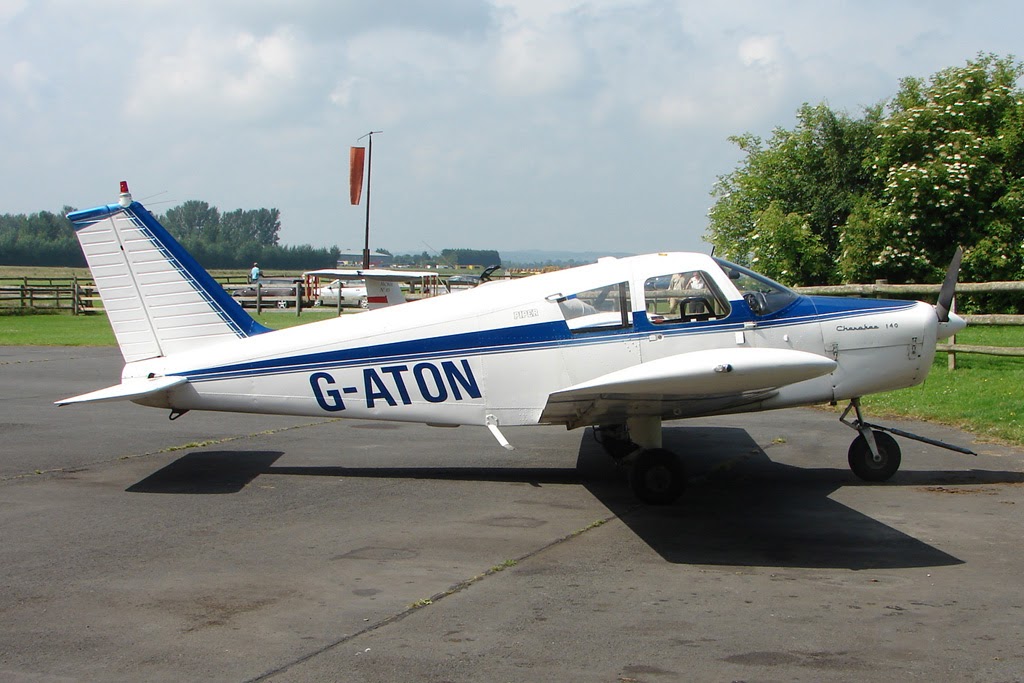
Recent work on G-ATON
- New transponder
- Front seats rebuilt
- New ammeter
- Aileron reskinned
- New tyre
- Radio rewired
- New rotating beacon
- New navigation light cluster
- New spinner on loan
Future work on G-ATON
Planned for the next Annual/ARC
- Replace the door seal.
- Fit a matching pair of new sun visors.
- Re-weigh G-ATON.
Longer-term work
- Bare-metal respray.
The Piper PA-28: development and manufacture
The Piper PA-28 Cherokee was developed at the end of the 1950s to give private owners and flying schools a practical, economical light aircraft. Its design brought together the work of Fred Weick, John Thorp and Karl Bergey. The prototype first flew in 1960, and Piper introduced the Cherokee to customers in 1961. [1]
The original aircraft combined an aluminium airframe with a low wing, fixed tricycle undercarriage and a Lycoming engine. Its rectangular wing, often nicknamed the “Hershey bar”, was a distinctive feature of early Cherokees. Straightforward construction and uncomplicated systems helped make the design suitable for both training and everyday touring. [2]
Manufacture became closely associated with Piper’s Vero Beach facility in Florida, which developed into the company’s headquarters and a major production centre. The Cherokee represented an important step in Piper’s move towards modern metal aircraft, following earlier designs such as the fabric-covered Cub and Tri-Pacer. Its basic layout provided a platform that Piper could develop for different roles without starting again with an entirely new aircraft. [3]
The family expanded through a succession of engines, cabin improvements and equipment options. Piper introduced the Cherokee 140 in 1964, particularly for the training market. Other developments included the Warrior, Archer and Dakota, while the Arrow added retractable undercarriage and a constant-speed propeller. Later members of the family adopted a tapered outer wing, changing the appearance of the original design. [4]
The PA-28 story continues through modern Archer aircraft, with contemporary avionics and interiors built around the familiar Cherokee concept. This long evolution connects today’s training fleets with aircraft from the earliest production years. Our own G-ATON, manufactured in 1966 and fitted with a 150 hp engine, belongs to that early generation: a recognisable example of a design that has served generations of pilots and remains familiar at airfields throughout the United Kingdom. [5]
Dimensions
- Wingspan
- 30 ft≈ 9.14 m
- Length
- 23.3 ft≈ 7.10 m
- Height
- 7.3 ft≈ 2.23 m
- Wing area
- 160 sq ft≈ 14.86 m²
Engine & propeller
- Engine power
- 150 hp
- Engine status
- Low hours
- Engine
- Lycoming O-320-E2A
- Displacement
- 319.8 cu in
- Compression ratio
- 7:1
- Propeller
- SENSENICH M74DM6-0-58
Fixed pitch · aluminium alloy - Propeller diameter
- 74 in
The handbook’s 150 hp configuration is rated at 2,700 rpm and uses a 58 in pitch propeller. The engine model, propeller diameter and pitch are handbook references; the installed propeller model is confirmed by the syndicate.
Owner’s Handbook · pp. 2 & 5Fuel & oil
- Required fuel grade
- 100LL AVGAS
- Fuel tank arrangement
- 2 × 25 US gal
- Total tank capacity
- 50 US gal ≈ 189 litres
- At filler-neck indicators
- 36 US gal ≈ 136 litres
- Oil grade
- AeroShell W80
- Oil capacity
- 8 US qt ≈ 7.6 litres
At Shobdon, 100LL AVGAS is available 24 hours a day, seven days a week, using the group’s fuel fob.
Fuel quantities here describe total capacity and the handbook’s standard filling level, not verified usable fuel for G-ATON. Oil capacity is not a topping-up instruction.
Owner’s Handbook · pp. 3 & 8Tyre pressures
- Main wheels · each tyre
- 24 psi ≈ 1.65 bar
- Nose wheel
- 24 psi ≈ 1.65 bar
Handbook pressures for the standard PA-28-140 installation.
Weights & performance
Performance figures use Piper’s 150 hp / 2,150 lb handbook configuration. They assume standard aircraft at that gross weight, standard atmospheric conditions and sea level unless another altitude is shown. Approach speeds follow the handbook’s landing guidance described below. Speeds retain the handbook’s mph units, with conversions in parentheses rounded to the nearest knot.
| Handbook figure | 150 hp configuration2,150 lb gross weight · ≈ 975 kg |
|---|---|
| Engine rating | 150 hp / 2,700 rpm |
| Propeller pitch | 58 in |
| Take-off ground run · flaps up | 800 ft |
| Take-off over a 50 ft obstacle · flaps up | 1,700 ft |
| Best-rate climb speed | 85 mph (74 knots) |
| Rate of climb | 660 ft/min |
| Service ceiling | 14,300 ft |
| Cruise · 75% power at 7,000 ft, without wheel fairings | 130 mph (113 knots) |
| Stall speed · flaps down | 54 mph (47 knots) |
| Normal approach · flaps up | ≈85 mph (74 knots) |
| Normal approach · full flap (40°, derived) | ≈76 mph (66 knots) |
| Landing ground roll · flaps down | 535 ft |
The full-flap approach value is calculated from the handbook’s flaps-up speed and its reduction per flap notch, using all three notches. The handbook does not give a separate nil-wind speed; flap use and landing speed depend on wind, loading and runway conditions. Approach and landing · pp. 19–19a; flap positions · p. 8.
These are published reference figures, not runway calculations or an operating speed card. G-ATON’s approved maximum weight, empty weight, useful load and limitations must come from its own documents.
Read the handbook
Piper’s Cherokee 140 Owner’s Handbook, P/N 753-584, is listed for 1964–1968 aircraft in Piper’s publications catalogue. The linked scan is hosted by Houlton Flying Club. Metric figures on this page are rounded conversions.
Interested in a share in G-ATON? View current availability and joining information.